
What Size Trampoline Do I Need? An Easy Guide.
Disclaimer: This website exists thanks to you, the readers. When you buy through links on my site, I may earn an affiliate commission.
Picking a trampoline size sounds simple. Then you start measuring the yard, worrying about weight limits, and wondering if the kids will outgrow it in a year.
This guide walks you through it the way I'd explain it to a friend. You'll get a full trampoline size chart and a simple way to measure your yard.
What size trampoline do I need? The short answer.
Start with your yard, not the trampoline. You need 3 to 6 feet of clear space on all sides. Whatever is left is the largest size trampoline you can get.
For most backyards and most families, that works out to a 12 or 14 foot round trampoline. Those two sizes are the most popular for a reason. They fit an average yard, they suit both kids and adults, and they leave room to actually move around.
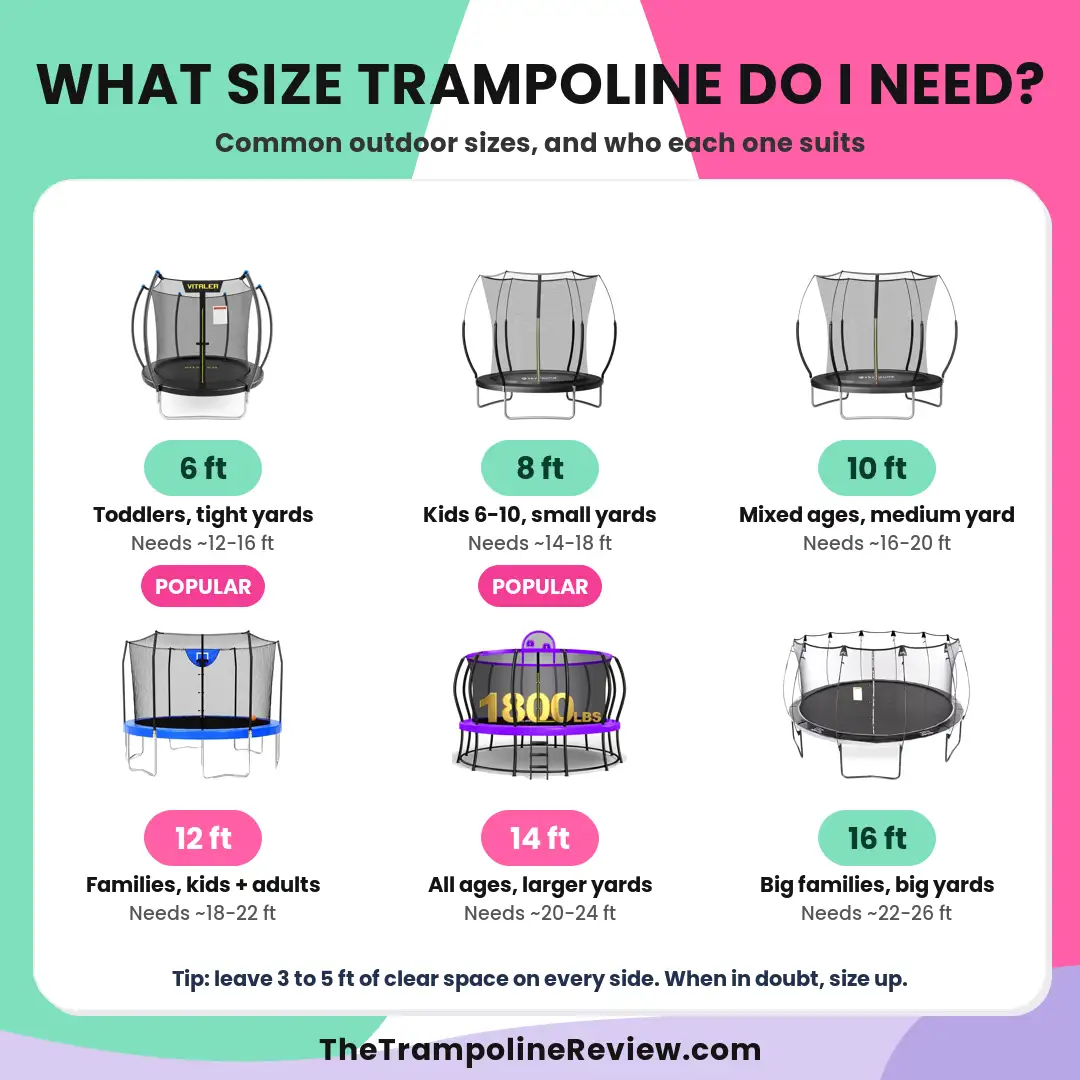
Smaller yards or younger kids can go 8 or 10 feet. Big yards and mixed-age families lean toward 14 or 16 feet.
When you're stuck between two sizes and you have the room, size up. I often hear people saying they should’ve gotten the bigger trampoline.
Here's how every common trampoline size compares.
Trampoline size chart (6 ft to 16 ft)
Outdoor trampolines come in a predictable ladder of sizes. The chart below shows who each size suits and how much total yard space it really needs once you add clearance. Age ranges are general guidance, not hard rules.
The "space needed" column already clearance on every side, so it reflects the real footprint, not just the frame.
Size | Best for | Total yard space needed (with clearance) | Example |
|---|---|---|---|
6 ft | Toddlers and young kids, tight yards | About 12 to 16 ft across | |
8 ft | Kids roughly 6 to 10, small yards | About 14 to 18 ft across | |
10 ft | Mixed ages, medium yards | About 16 to 20 ft across | |
12 ft | Families, kids and adults | About 18 to 22 ft across | |
14 ft | All ages, larger yards | About 20 to 24 ft across | |
15 ft | Active kids and teens, adults | About 21 to 25 ft across | |
16 ft | Big families, lots of jumping room | About 22 to 26 ft across |
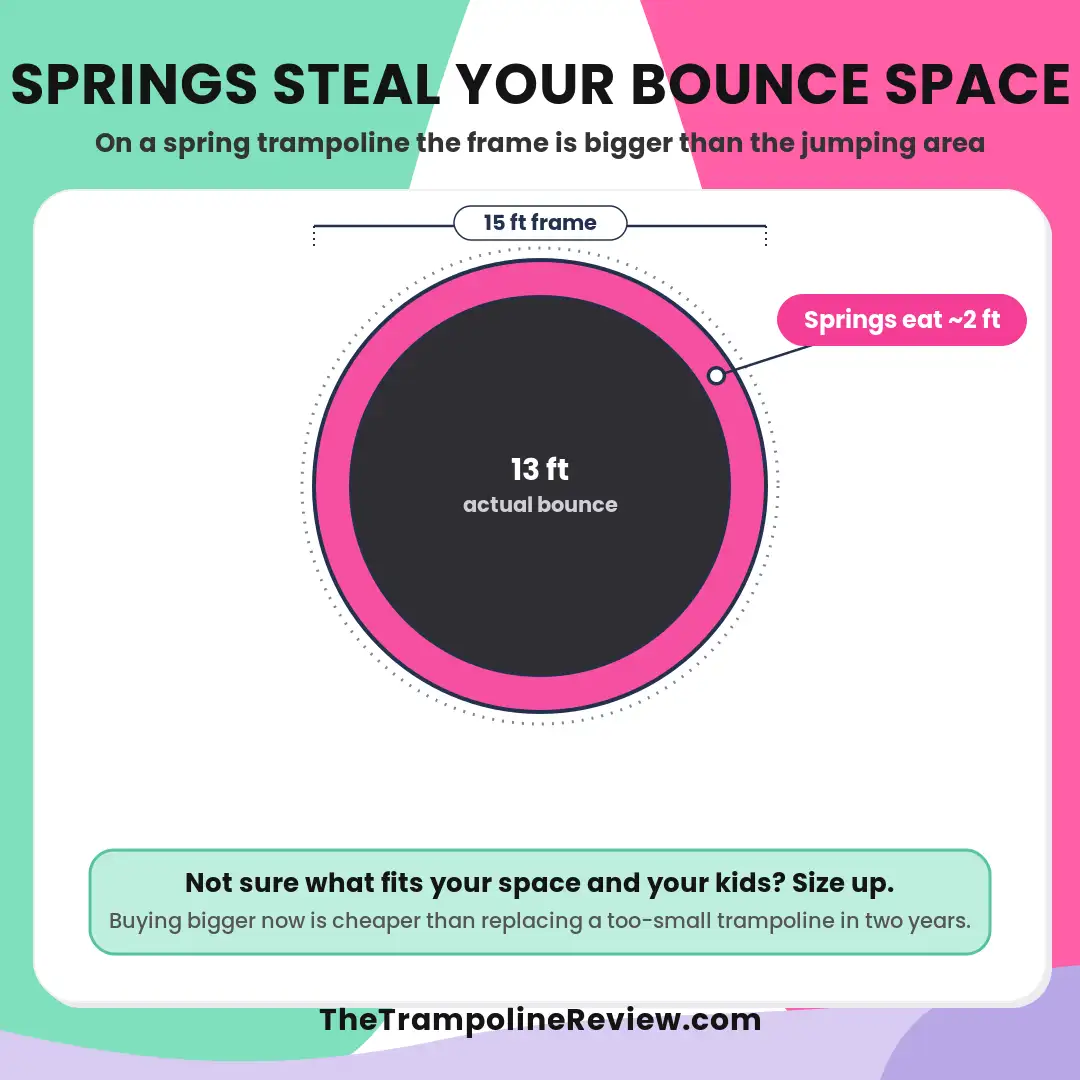
One thing to keep in mind. On a spring trampoline, the springs eat up about 2 feet of usable jumping space. So a 15 foot spring trampoline gives you closer to 13 feet of actual bounce room.
If you are not sure what size fits your space and your kids, size up rather than down. Buying bigger now is cheaper than replacing a too-small trampoline in two years.
And one more thing. The spring system does most of the work, so more springs, or longer ones, generally mean a deeper, softer bounce.
Don’t forget clearance
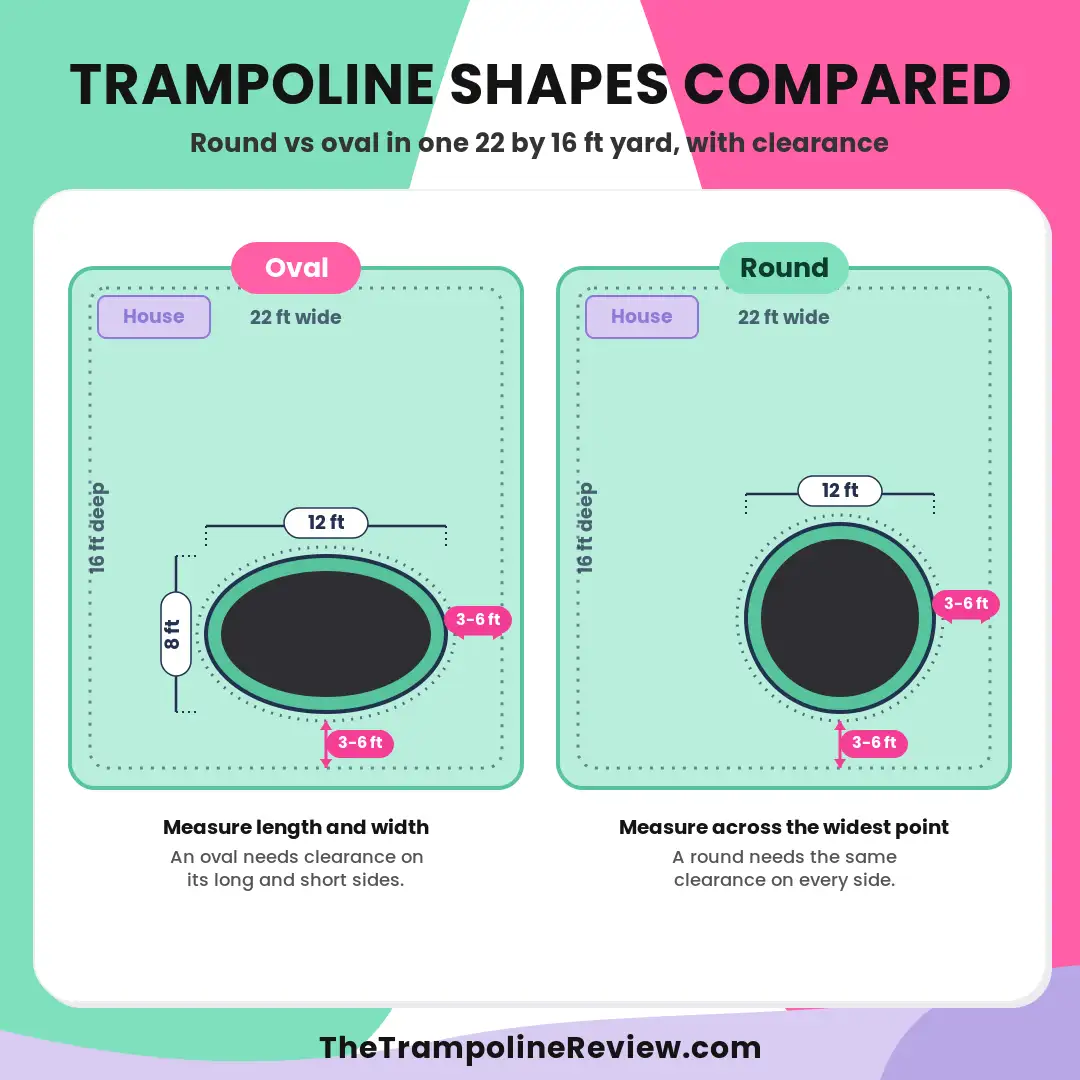
Before you decide on size, measure the space. Add 3 to 6 feet of clearance space on every side of the trampoline. That's your safety zone. Grab a measuring tape and mark out the frame plus that clearance on the grass before you buy.
Check the height too. A trampoline with a safety enclosure can stand 6 to 10 feet tall, so watch for branches, eaves, and power lines overhead.
Keep the area under and around the trampoline clear of fences, sheds, and hard surfaces.
Trampoline shape
Two trampolines with the same "size" can fit your yard differently and even bounce differently. Shape is the reason.
For example, an oval trampoline can fit better if your yard more of a rectangle form. A round trampoline can be better for a yard that leans towards a square.
If you have the length for it, a rectangular trampoline gives serious jumpers the most usable surface, while a square trampoline splits the difference between a round and a rectangle.
After shape, weigh up the practical stuff: spring or springless, above ground or in ground, budget, and warranty. Above-ground trampolines are the standard, easy-to-move option, whereas in-ground trampolines sit aligned with the lawn for a more tidy look.
None of these change the size you need, but they decide which model you actually buy. Check out my guide on how to choose a trampoline for more information.
Now to a question many parents actually type into Google.
What size trampoline for 3 kids?
The American Academy of Pediatrics recommends that only one person jump on a trampoline at a time. That's because most injuries happen when several kids bounce together.
The child most likely to get hurt is the smallest one, and a big cause is the "double bounce," where one jumper lands and launches another into the air.

That being said, if you want three kids to be able to jump on a trampoline, 14 feet is the sweet spot. It gives enough room for three to bounce without constantly crashing into each other. If your kids are older, more active, or you want adults to join in, size up to 15 or 16 feet.
So here's the realistic middle ground. If your kids are going to bounce together, and let's be honest, they probably will, a bigger mat plus a few simple habits lowers the risk:
- Buy the larger size (14 to 16 feet) so there's more room between jumpers.
- Keep a grown-up watching every session.
- Match jumpers by size where you can, and take turns for the little ones. For small kids (under 6), you might want to consider an indoor toddler trampoline instead.
- No flips, and keep the safety net zipped shut.
Common sizing mistakes
Most sizing regrets trace back to the same handful of avoidable slip-ups.
- Buying to fit the yard exactly, with no room left for the safety clearance.
- Ignoring the single-jumper weight capacity and finding out the hard way.
- Choosing a size a child outgrows in a couple of years.
- Forgetting the overhead height once the enclosure is on.
- Assuming a bigger trampoline is less bouncy. It isn't. Bounce depends on the mat, the springs, the jumper, and the shape, not the diameter.
If you're torn between two sizes and you have the space, go bigger.
Frequently asked questions
What's the most popular trampoline size?
The 12 and 14 foot round trampolines are the most common. They fit an average yard and work for both kids and adults.
What size trampoline is best for adults?
Look at 14 feet or larger, and check the single-jumper weight capacity before you buy so it comfortably covers the heaviest jumper. You might also want to consider a square or rectangle trampoline for adults to avoid injuries and let them do tricks like backflips.
And if you want to use the trampoline for fitness, check out the ones made for that – rebounders.
Are bigger trampolines less bouncy?
No. Bounce comes down to mat firmness, spring quality, the jumper's weight, and the shape. Diameter alone doesn't decide it.
What's the biggest trampoline I can buy?
16 feet is the largest common outdoor size. Anything bigger tends to be specialty gear. However, there are also some extremely big trampolines on the consumer market. Like the Akrobat Megatramp.
How do I measure a trampoline?
If you’re doing this live, in a store, measure across the widest point of the frame, outer edge to outer edge, for a round model. For a rectangle, measure the length and the width separately.
Alternatively, check the manufacturer’s website. The frame diameter advertised, edge to edge, is the figure you need to match against your yard.
Conclusion
Sizing a trampoline really comes down to two things: the space in your yard including clearance and the shape that suits your setup. Nail those and the right size becomes obvious, and for most families it's a 12 or 14 foot round.
If you take one thing away, it's this. Measure your yard first, add your clearance, and when you're on the fence between two sizes, go bigger. Then jump safely, one at a time, where you can.
References and further reading
- Are Trampolines Safe for Kids? (AAP, HealthyChildren.org)
- Trampoline Safety in Childhood and Adolescence (AAP policy statement, Pediatrics)
- Trampolines and Trampoline Safety (AAOS position statement)
- How to Jump on a Trampoline: Safety Tips and Rules
- Benefits of Trampolines for Toddlers
- Mini Trampoline Age Range for Kids
- The Best Outdoor Trampolines Compared
