
How Much Does a Trampoline Cost? (Price Guide)
Disclaimer: This website exists thanks to you, the readers. When you buy through links on my site, I may earn an affiliate commission.
Search "trampoline cost" and you get two kinds of answers. Bare retailer listings with no context, or brand blogs quietly steering you toward their own product. Neither one just tells you the number.
So here it is.
This guide breaks down what a trampoline really costs. Price by type, by size, and by shape. Then the extras that catch first-time buyers off guard, like accessories, installation, upkeep, and even your home insurance. By the end you will have a realistic budget for the trampoline and everything around it.
How much does a trampoline cost?
A basic backyard trampoline starts around $200 to $400 at a big-box store. Mid-range trampolines are in the $400 - $900 bracket. A premium outdoor trampoline can be between $1,500 and 4,000. An-ground setup can run $1,000 to $5,000 or more. Where you land depends mostly on the type, the size, and how it gets installed.
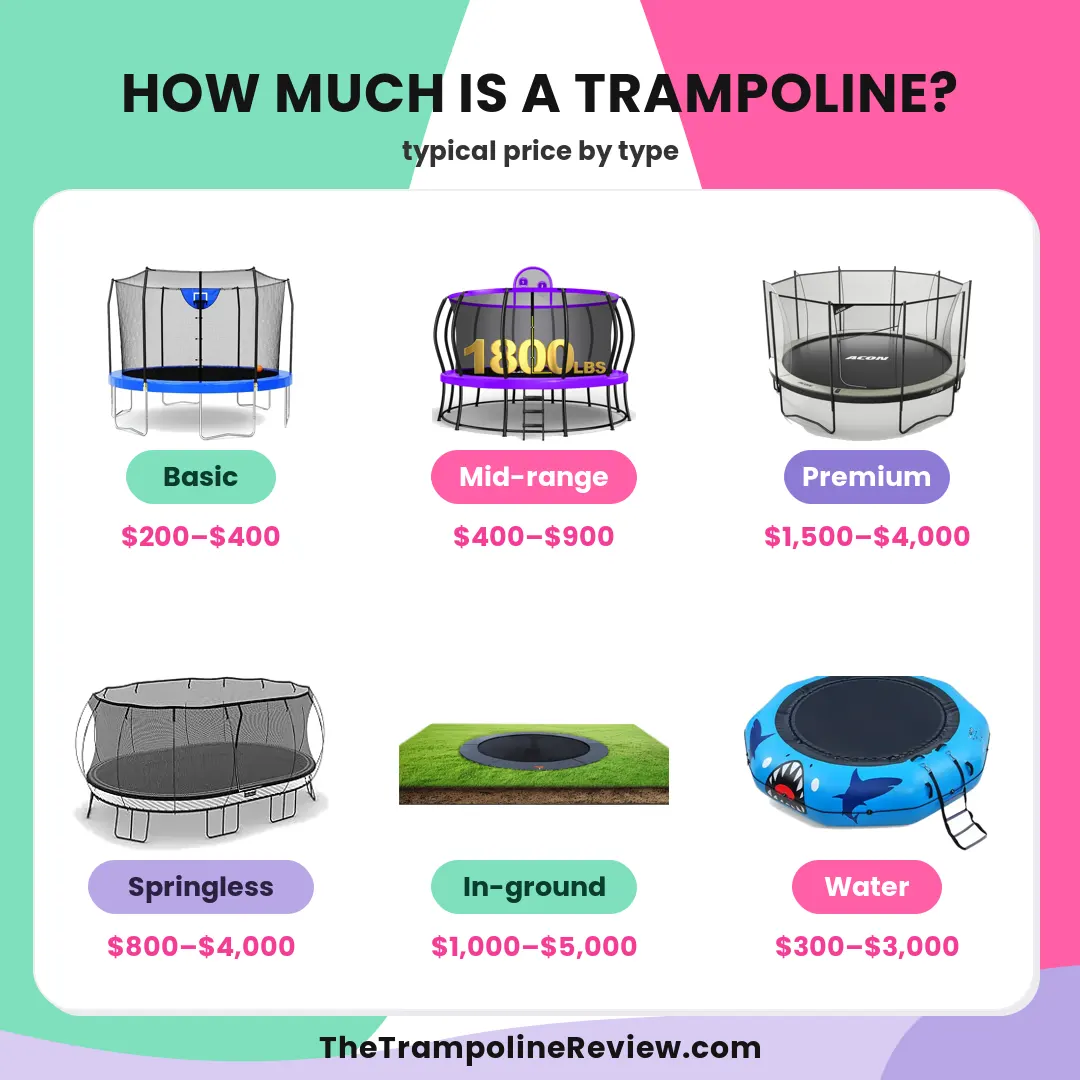
Here is the quick rundown of the different prices of trampolines before we dig into the why.
Type of trampoline | Typical price range | Best for | Example |
|---|---|---|---|
Basic backyard trampolines | $200 - $400 | Families that need a budget trampoline | |
Mid-range backyard trampolines | $400 - $900 | Families that want the most value for their money | |
Premium backyard trampolines | $1,500 - $4,000 | Families that want a long-lasting trampoline | |
Springless backyard trampolines | $800 - $4,000 | Safety-first buyers, young children | |
In-ground | $1,000 -$5,000+ (before install) | A permanent, low-profile backyard feature | |
Water trampoline | $300 - $3,000+ | Lakes, ponds, and summer fun |
Trampoline price by size and shape
The price of a trampoline climbs with size, of course. A bigger jumping surface needs a bigger frame, bigger mat, and more springs or rods, so it costs more to build.
Here is how that looks across three models of the same brand (Skywalker), so you can see trampoline size alone at work.
Size and shape | Typical price range | Best for | Example |
|---|---|---|---|
Compact round (8 ft) | ~$249 | Small yard, one kid | |
Medium round (12 ft) | ~$399 | Growing family | |
Large round (15ft) | ~$499 | Multiple kids, room to grow |
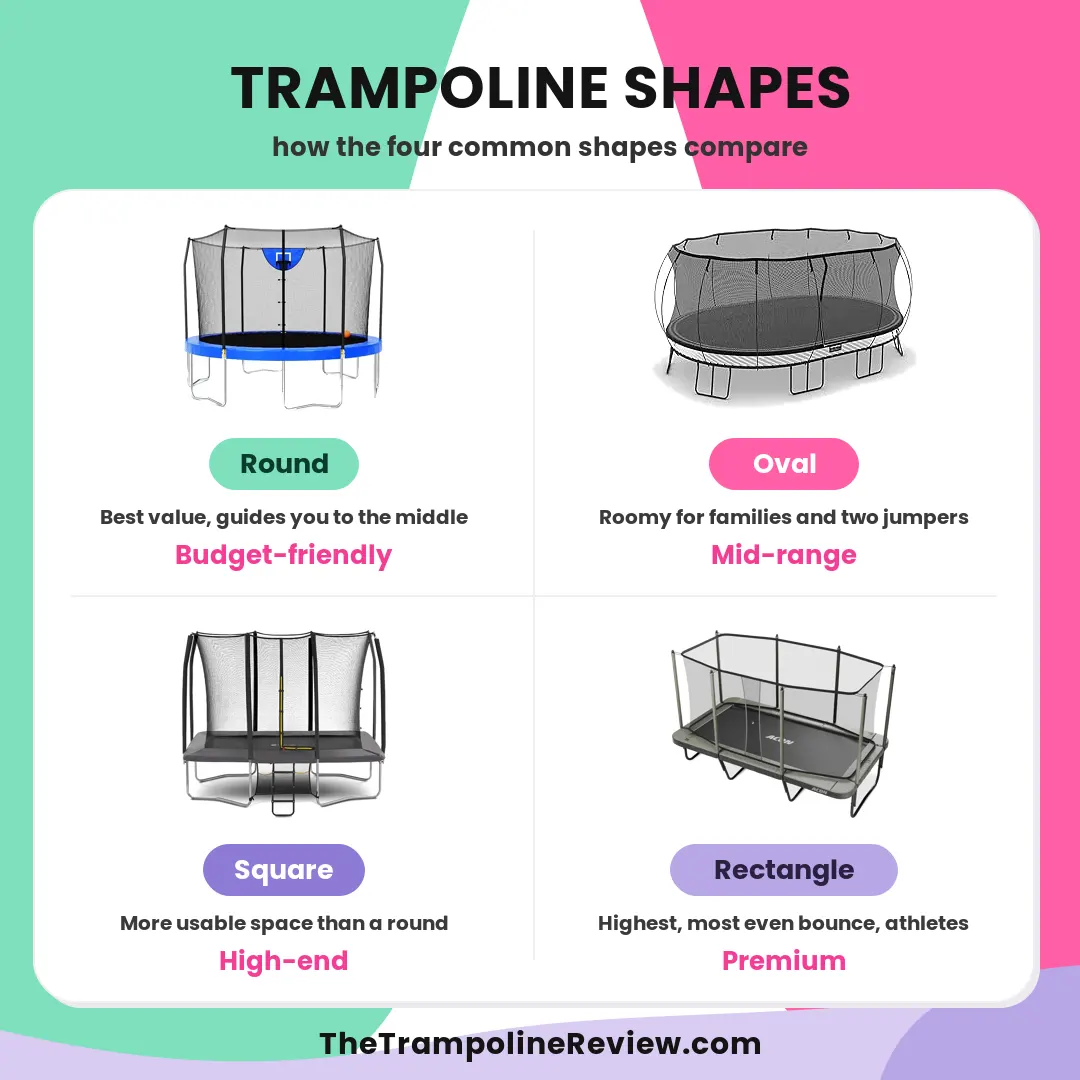
Shape matters too. Round and oval trampolines are usually cheaper than square or rectangle ones of a similar footprint.
A common 14 to 15 foot round model runs around $300 to $1,000 with springs, while square and rectangle models tend to sit between roughly $800 and $4,500.
What makes one trampoline cost more than another
Two 14 foot trampolines can be $800 apart or even more. The gap almost always comes down to materials, safety design, and warranty.
Materials and frame. A galvanized steel frame and springs resist rust and hold up to heavy use. Cheaper metal bends, rusts, and gives out sooner. Better mats and thicker safety pads also add to the price.
Safety design. Where the springs sit, how the net attaches, and how the poles are padded all affect both safety and cost. Premium models are tested to serious loads. Some frames are rated to withstand up to 1,650 lbs.
Warranty and certification. A longer warranty is a quick proxy for quality. It tells you how long the maker expects the trampoline to last. Look for trampolines that meet ASTM International safety standards, the main US benchmark for trampoline design, and carry warranties in the range of 5 to 10 years on the frame.
Here is the short version of what your extra dollars buy:
- A rust-resistant galvanized steel frame that lasts longer
- Springs or composite rods that bounce better and wear slower
- A tighter, safer enclosure net and thicker padding
- A longer warranty that signals real durability
The takeaway is simple. If a trampoline will get heavy use for years, the pricier build usually earns its keep.
The extra costs of a trampoline people forget
The sticker price is rarely the final price. Plan for these before you buy.
Accessories. A trampoline often needs or wants a few add-ons. Typical prices look like this:
Cost item | Typical price | Notes |
|---|---|---|
$20 to $99+ | Helps kids climb on safely | |
$20 to $99+ | Keeps the trampoline from blowing away | |
$20 to $199+ | Protects the mat between seasons | |
$30 to $249+ | The most popular fun add-on |
With some trampoline manufacturers, some or even all of these may come with your trampoline. But many sell them as add-ons. I think they are almost essential. Especially the ladder and the anchor kit.
For example, this Zupapa backyard trampoline comes with a ladder and basketball hoop but no anchor kit. At the same time, premium brands like Springfree sell each of these separately.
Installation and assembly. You can build most above-ground trampolines yourself in an afternoon. If you don’t want to, professional assembly runs about $100 to $500 depending on the model and your location.
In-ground installation. This is the big one. Putting a trampoline into the ground is a real project, and the total usually lands between $1,500 and $5,000 or more. The labor alone can reach $3,500. Here is roughly where that money goes:
- Excavation and digging the hole: $400 to $1,500
- A retaining wall to hold the shape: around $2,000
- A drainage system: a few hundred to a few thousand dollars
- The in-ground kit itself: often $2,000 to $2,800 for a mid-size model
Maintenance and replacement parts. Cleaning is cheap, just soap and water. But a new net or mat down the road can cost $100 or more. Check your warranty first. It may cover the part.
Homeowners insurance. This one surprises people. A backyard trampoline might raise your premium or trigger extra liability requirements from your insurer. It is worth a quick call before you buy.
Add it up and a $400 trampoline can quietly become a $700 project. Budget the extras from the start.
Cheap versus premium: Is an expensive trampoline worth it?
Kids can bounce on a $250 trampoline and a $1,600 trampoline. So what does the extra $1,350 actually buy? Mostly durability and safety, and whether that is worth it depends on how you will use it.
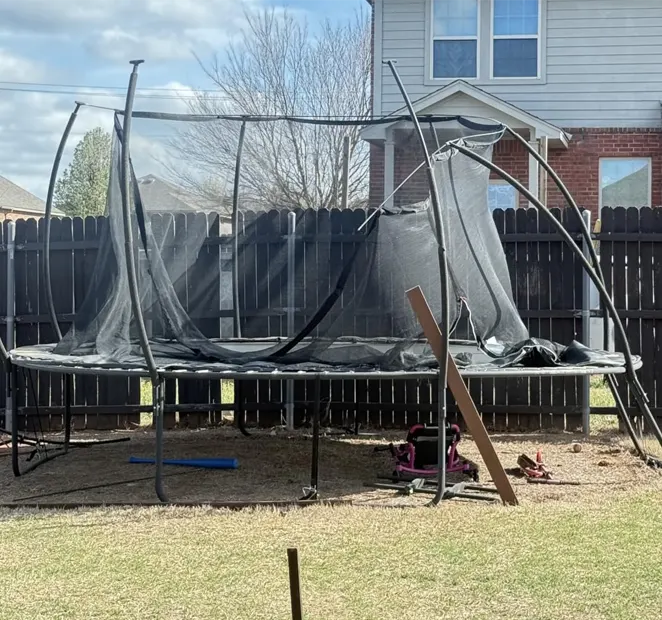
Trampolines can carry real injury risk. A cheap, flimsy build does not create that risk, but it can make it worse. Thin frames flex, nets sag, and worn springs pinch. So the money you spend on a sturdier frame and a better enclosure is money spent lowering the odds of a bad landing.
Cheap trampoline
Premium trampoline
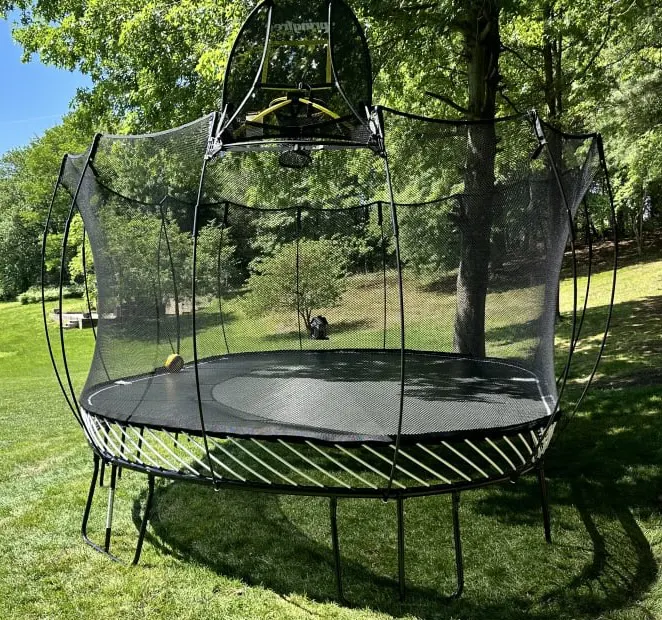
There is also the replacement math. A budget trampoline that lasts two years and gets tossed is not really cheaper than a mid-range one that lasts six.
When cheap is fine: light, short-term use, one or two kids, and you are diligent about the safety net.
When it is a false economy: heavy daily use by several kids for years. In that case a mid-range or better model usually pays for itself in longer life.
How to spend less on a trampoline
You do not have to overpay. A few timing and inspection habits cut the cost without leaving you with junk.
- Buy at the right time. Trampoline prices dip in the off-season and around big sale events like Black Friday. If you can wait for fall or winter, you will often save.
- Buy used, carefully. A secondhand trampoline can be a bargain. Before you hand over cash, check the frame for rust, inspect the mat and net for tears, and confirm no parts are missing. Skip anything with a bent frame.
- Assemble it yourself. Skipping professional assembly saves $100 to $500 right away, and most outdoor trampolines come together in an afternoon.
- Stick to the size you need. A right-sized round trampoline from a known brand beats an oversized cheap one you will replace.
The cheapest safe route is usually a mid-size trampoline from a known brand, bought off-season, and assembled at home.
Trampoline cost FAQ
How much is a good trampoline for a family?
For most families, a 12 to 14 foot trampoline is the sweet spot. Traditional spring trampolines can go as low as $350 to $1,500. A springless family trampoline with better safety features sits higher, often above $1,500.
Why are some trampolines so expensive?
The price comes from materials, safety design, warranty length, and brand. Springless models cost more than spring ones because composite rods are pricier than steel springs. You are paying for a build that lasts longer and lands safer.
What are the hidden costs of owning a trampoline?
Beyond the trampoline itself, budget for accessories ($20 to $250 each), assembly ($100 to $500), replacement parts ($100 or more over time), and a possible bump in your homeowners insurance.
The bottom line
A trampoline's price depends on a few things. The cheapest trampolines are the round ones with springs. Other shapes and springless designs cost more.
In the end, the quality of the materials decides the final price of a trampoline. Then you have to budget for the extras.
So set a total budget before you shop. A fair rule is the trampoline itself plus another $150 to $400 for the stuff around it. Pick the type that matches how your family will actually use it, then buy the safest build you can afford in that bracket. That is how you get years of fun without overpaying or cutting the wrong corner.
