
How Much Weight Can a Trampoline Hold? Trampoline Weight Limits Explained
Disclaimer: This website exists thanks to you, the readers. When you buy through links on my site, I may earn an affiliate commission.
You want a reliable trampoline in the backyard but then you start comparing them, and the weight limits make no sense. One brand brags about 1,500 lbs, the next says 300 lbs, and they look like the same trampoline.
So, how much weight can a trampoline hold?
The short answer: most full-size trampolines hold a single jumper of roughly 200 to 300 lbs, take around 400 to 600 lbs of people jumping together, and can bear 1,000 lbs or more of still weight.
The confusion starts because trampolines have three different weight limits, and each one measures something different. Let's break them down.
Key takeaways
- A trampoline has three weight limits: single jumper, dynamic, and static.
- Single jumper weight limit (one person): often 250 to 300 lbs.
- Dynamic (everyone bouncing at once): usually 400 to 600 lbs.
- Static (still weight): 1,000 lbs or more, but never buy on this alone.
- Bigger trampoline usually means higher weight limits.
The three trampoline weight limits you need to understand
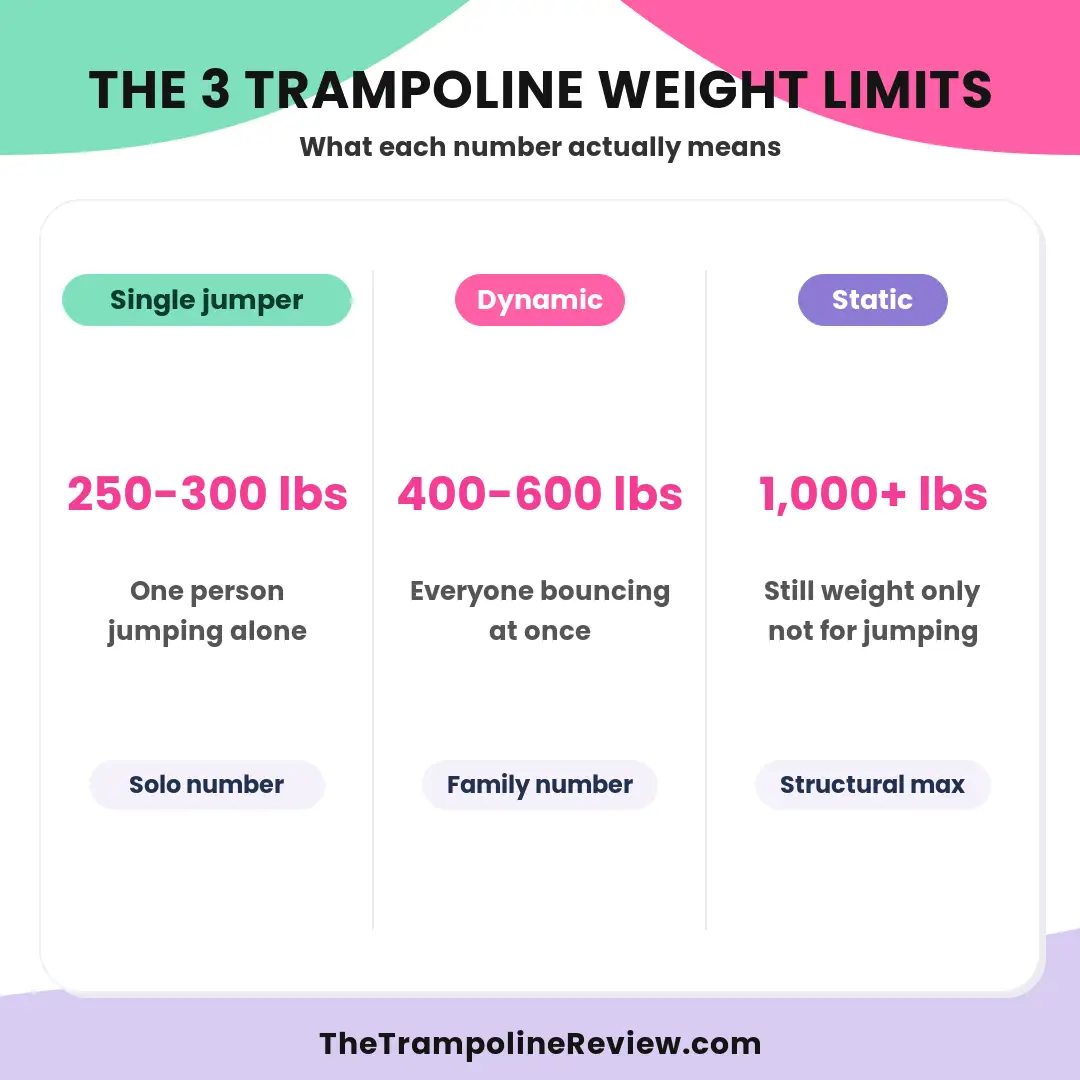
Let's break down the three weight limits.
Single jumper weight limit
This is the most one person should weigh when using the trampoline alone. You'll also see it called the single-user or static user weight. It is usually the smallest of the three, often around 250 to 300 lbs on a standard model. It can grow bigger as the trampoline’s size gets bigger.
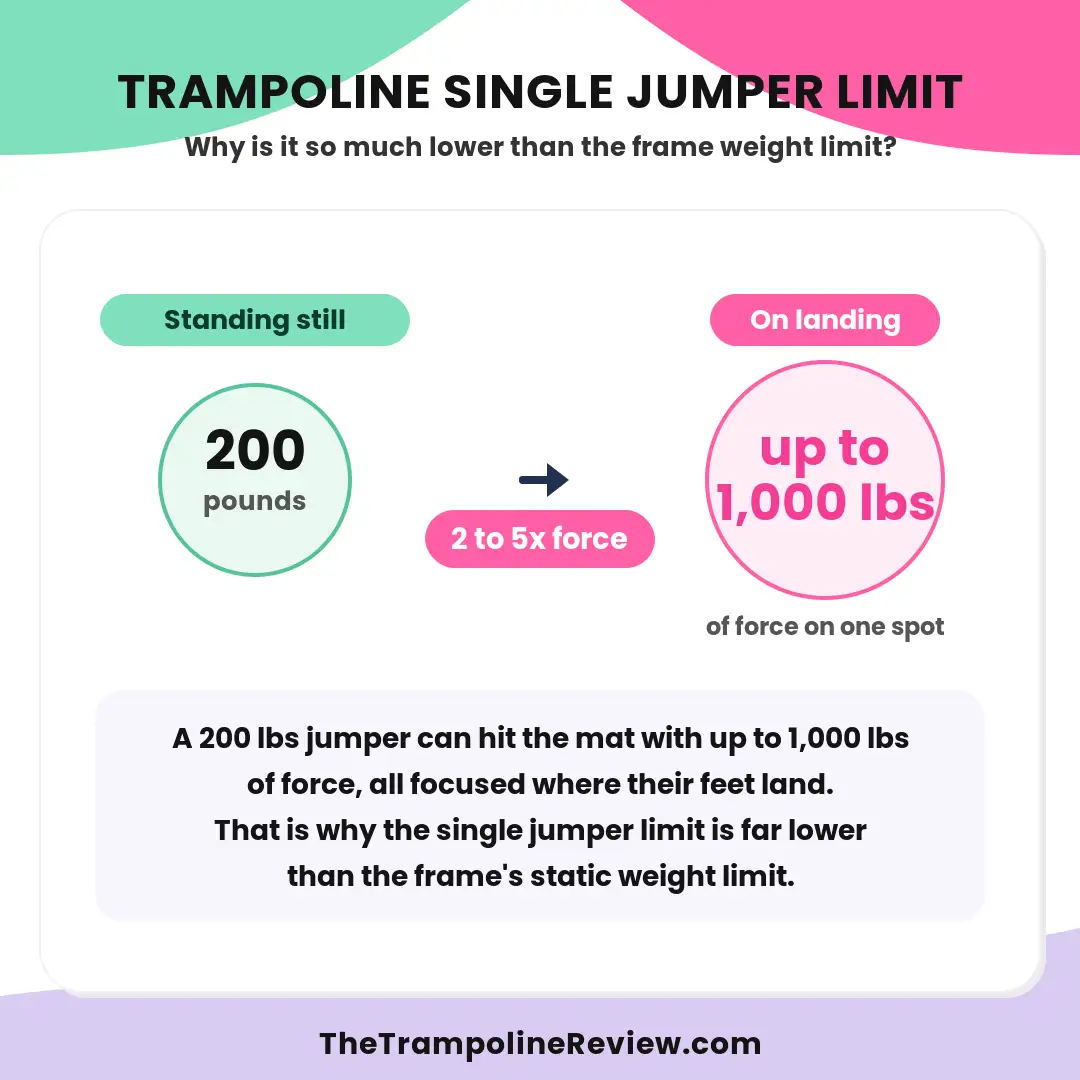
But here’s the part that surprises people. When you land, you hit the mat with 2 to 5 times your body weight, all focused on the little patch of mat under your feet. So a 200-pound adult can briefly hit the mat with several hundred lbs of impact force.
Dynamic weight limit
The dynamic limit is how much the trampoline can handle when people are jumping. Picture a few kids bouncing at once. Their weight lands on different spots, at different moments, with different dynamic forces, so the load is constantly shifting across the mat, springs and frame.

Most trampolines land somewhere around 400 to 600 lbs here, and 500 lbs is common.
This is the number to check when you're wondering, "Can all my kids jump together? Can I get on with them?" Add up the weight of everyone bouncing at the same time and keep that total under the dynamic limit.
Static weight limit
The static limit is the most still weight (people standing still on the trampoline) the frame can hold without bending, snapping or giving way. It is the biggest of the three, and any number above about 1,000 lbs a brand advertises is almost always this one.
It gets tested by stacking weight, usually big metal plates, onto the center of the mat until something starts to give.
A trampoline rated at 1,500 lbs static can hold quite a few people sitting still. But that tells you nothing about people jumping, so don't buy on this number alone.
Trampoline weight limits by size
As a rule, the bigger the trampoline, the higher all three limits climb. It isn't a perfectly even jump, though, so treat these as ballpark single jumper figures and check the exact model. Fourteen foot trampolines are the most popular size, and it's easy to see why, since they suit growing families.
Size | Typical single jumper limit | Example |
|---|---|---|
8 ft | 175 to 200+ lbs | |
10 ft | 200 to 250+ lbs | |
12 ft | 200 to 270+ lbs | |
14 ft | 200 to 235+ lbs | |
16 ft | 200 to 250+ lbs |
Brands vary a lot inside these ranges. And this brings us to the question everyone should ask.
What determines a trampoline's weight limit?
A weight limit isn't one part doing the work. It's the springs, frame and mat, the whole trampoline together. Here’s how this works:
- Springs or bungee cords. They take most of the force when you jump. A higher spring count and stiffer springs, raise the limit, though very stiff springs give you a lower bounce. That’s the trade-off.
- The frame. A thicker, rust-resistant steel frame is more stable. Better models use hot-galvanized steel, and some makers say their frames handle several times the recommended weight when the load is spread evenly.
- The mat. A UV-resistant woven polypropylene mat with strong stitching holds its shape, especially at the edge where the springs attach.
- Size. Bigger trampolines carry more than small ones.
- Shape. Rectangular and oval models often hold more, because the springs sit closer to the bounce area and share the load.Rectangular trampolines in particular spread the load across more springs.
These parts differ from model to model, so the numbers do too. That's exactly why two trampolines that look similar can list very different limits.
Why brands' weight limits aren't directly comparable
Two near-identical trampolines can advertise wildly different weight limits, and both can be telling the truth.
How the limit is tested
Most ratings come from a static load testing. Weight goes onto the center of the mat until it stretches down close to the ground, then a safety divisor is applied. The divisor is where it gets slippery.
One national standard loads the mat until it deflects 80 percent of the way down, then divides the deadweight by five. So 1,700 lbs on the mat becomes a 330 lbs rating.
An older method divided by three instead, which would turn the very same trampoline into a 550 lbs rating.
As a rough rule, a trampoline should be proven to hold a static load 3 to five 5 times its advertised single user weight limit.
Standards and why numbers still differ
Consumer trampolines in the US are covered by ASTM F381-24, the current industry standard safety specification. It requires makers to state the single jumper weight rating and label their trampolines clearly.
What it can't do is force every brand to test the same way, use the same divisor, or resist quoting the biggest number. Some lead with the static figure, others with the single jumper one.
So what can you do to be sure your trampoline can hold enough weight? Before you buy, ask three quick questions:
- Which limit is this, static, dynamic, or single jumper, and which test produced it?
- Was this exact size tested, or was one result stretched across the whole range?
- What is the frame warranty, and how thick is the steel tubing?
What happens if you exceed the weight limit?
Going over the limit doesn't always mean instant disaster. But the safety risks stack up, and they differ depending on which limit you cross.
- Past the single jumper limit: you risk "bottoming out," touching the ground or springs at the bottom of a bounce. That's a fast route to a sprain or worse.
- Past the dynamic limit: too many jumpers at once overloads the mat and springs in motion, wears them out faster, and raises the chance of a tear.
- Past the static limit: the springs stretch and lose their bounce, the frame can bend, and the mat can tear. Push far enough and the frame fails, and there goes your warranty.
Here is the reassuring bit. Damage almost always arrives in small steps, not one dramatic collapse.
On a decent modern trampoline you get warning signs long before anything gives way. The everyone-falls failures you see on YouTube usually involve a bare-bones budget trampoline or one that was badly overloaded for months.
Match the trampoline to how your family will actually use it, then keep an eye on its condition.
How to tell if your trampoline is nearing its limit
A trampoline lives outside all year, so a quick check every so often catches trouble early. Run through this short list:
- Frame and pipes: every section connected and locked, with no bending or wobble.
- Springs: all there, seated right, and springing back fully instead of looking stretched.
- Mat: no thinning, rot or small tears, especially near the edge where the springs hook in. That's the spot most likely to rip, particularly on a mat that has weathered a few years.
- Landing habits: big jumps that come down right at the edge, near those connecting points, hit the weakest point. Aim for the center.
Spot stretched springs, a thinning mat, or fraying near the hooks? Replace the worn part before the whole thing lets go. Catch it early and it's a cheap replacement, not a whole new trampoline. Plus, it’s safer.
How much weight capacity do you actually need?
The right weight limit depends less on the trampoline and more on who's getting on it. Here is how to think about it.
For kids, buy for growth
Little ones weigh next to nothing today, but they grow fast, and friends come over. Buying more capacity now means the trampoline lasts for years instead of getting outgrown in two.
For teens and adults
If teens or parents will jump solo, check the single jumper limit. Many standard models top out around 250 to 300 lbs for one person, so a heavier adult should look higher. Some 14 foot models are rated up to 450 lbs for a single jumper, which leaves plenty of room for a parent to bounce or work out.
For the whole family jumping together
This is where the dynamic limit earns its keep. Add up the weight of everyone bouncing at once and keep that total under the dynamic rating, often around 500 lbs.
A parent near 200 lbs plus a few kids can hit 450 lbs together, so a dynamic limit of 500 lbs or more lets you all jump at the same time. Even then, most makers still say one jumper at a time, because collisions cause more injuries than the mat ever will.
When in doubt, size the capacity up. Headroom above your heaviest use is never wasted.
High weight capacity trampolines worth knowing
If a high weight limit is your priority, a few models stand out. Just remember the point from earlier: the biggest number isn't automatically the best trampoline. Balance capacity against bounce, durability and warranty. Every figure below is the manufacturer's stated capacity.
Model | Single jumper limit | Dynamic weight limit (all jumpers) | Example |
|---|---|---|---|
265 lbs | 425 lbs | ||
No single user limit; tested up to 1,650 lbs | 1,650 lbs | ||
198 lbs | 550 lbs | ||
275 lbs | Not labeled | ||
220 lbs | Not labeled |
Frequently asked questions
Which weight limit should I actually check?
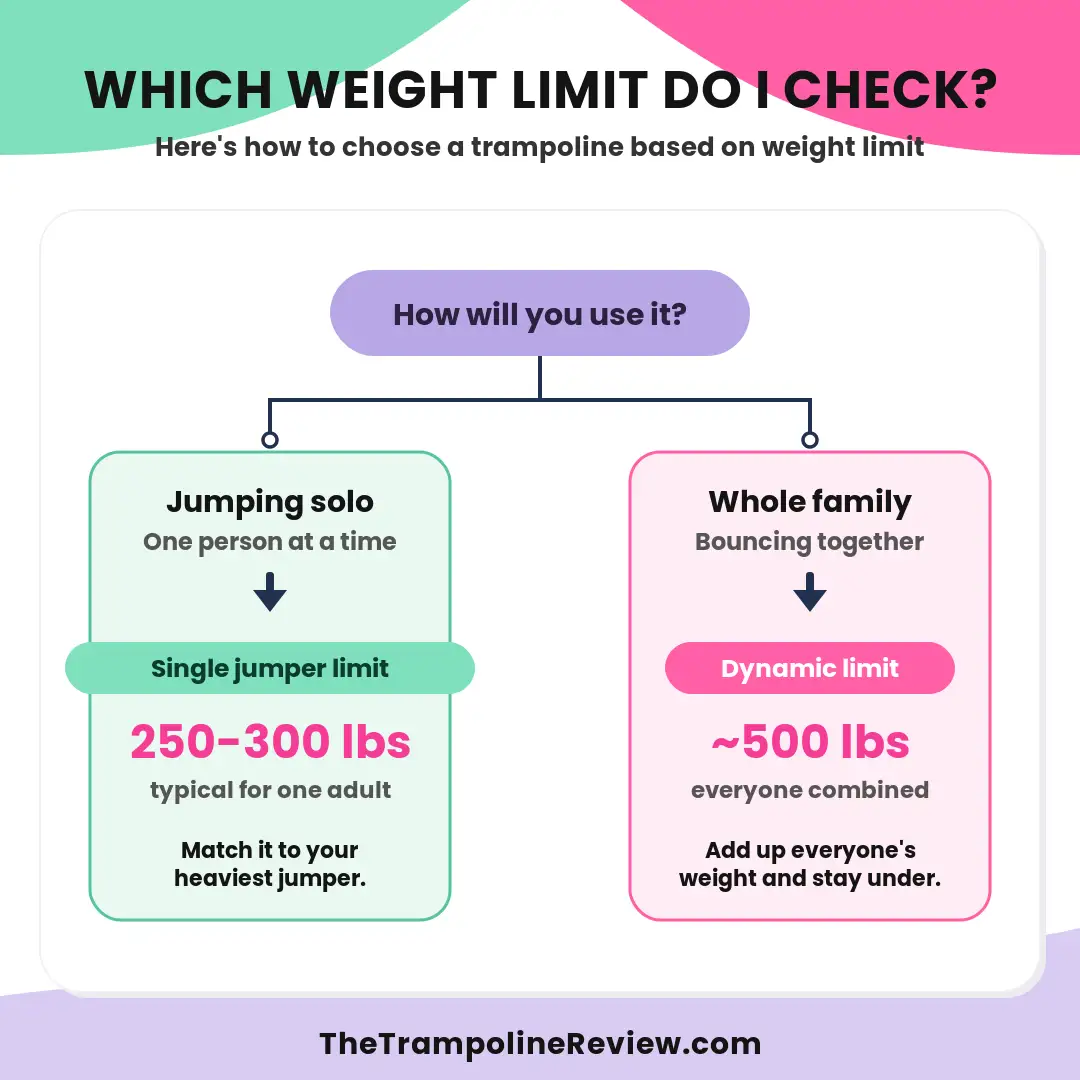
For solo use, check the single jumper limit against your heaviest jumper. For family jumping, check the dynamic limit against the combined weight of everyone bouncing together. The static limit is handy for judging structural strength, but it's not the number for everyday use, since it only applies to still weight.
Can more than one person jump at once?
Technically, yes, as long as the combined weight of everyone bouncing stays under the dynamic limit, which is often around 500 lbs. However, even when the math works, manufacturers still recommend one jumper at a time, because many trampoline injuries come from collisions between jumpers, not the mat failing. Those collision risks, not a failing mat, cause most trampoline injuries.
How much does a trampoline weigh?
That's a different question from how much it holds. The weight of the trampoline itself, meaning the frame, mat, springs and net, is separate from its load rating. A full-size backyard trampoline often weighs somewhere from 100 to 250 lbs packed, depending on size and build. That matters for assembly and moving, not for how much it can hold.
Is there a weight limit at trampoline parks?
Yes, but parks set their own rules, and they usually differ from home trampolines. Many list a per-person limit in the range of 250 to 350 lbs, so check the specific park's policy before you visit.
Can adults jump on a 12 ft trampoline?
Yes, an average-weight adult can. A 12-foot trampoline usually has a single jumper limit of 200 to 350 pounds, so most adults sit comfortably under it. Check the exact model's single jumper number against your weight, keep it to one person at a time, and aim for the center of the mat. If two adults want to bounce together, look at the dynamic limit instead. That’s often around 500 pounds.
How many pounds can a 15 ft trampoline hold?
It depends which of the three limits you mean. A 15 foot trampoline typically holds a single jumper of 200 to 450 pounds, handles roughly 400 to 600 pounds of people bouncing at once, and can bear 1,000 pounds or more of still weight. As one real example, the Jumpflex Hero 15 ft lists a 198 pound single jumper limit and a 550 pound total. Always check the specific model, since brands rate the same size very differently.
Can a 300 pound person jump on a trampoline?
Yes, but you need the right trampoline. Many standard models cap the single jumper limit at 250 to 300 pounds, so a 300 pound jumper is right at the edge on those. Look for a heavy-duty model with a single jumper limit of 300 pounds or more. Some 14 foot trampolines are rated up to 450 pounds for one person, which gives you real headroom. Jump one at a time, land near the center, and check the mat and springs regularly.
The bottom line
Match the single jumper limit to your heaviest solo jumper. Match the dynamic limit to the whole family bouncing together. Choose a brand with a clear test method and a solid trampoline warranty. Do that, give it a quick once-over now and then, and your trampoline will stay safe and bouncy for years.
Next: Check out the best outdoor trampolines
If you’re looking to get a solid trampoline that’s going to last you a long time, check out our vetted list of the best outdoor trampolines for every budget.
