
How to Choose a Trampoline: A Family Buyer’s Guide
Disclaimer: This website exists thanks to you, the readers. When you buy through links on my site, I may earn an affiliate commission.
Buying a trampoline should be the fun part of summer. Then you start shopping, and the choices pile up fast. Round or square? What size fits the yard? Springs or springless? It is easy to overthink it, and just as easy to buy the wrong one for your space.
This guide keeps it simple. Learning how to choose a trampoline really comes down to seven things, and we will walk through each one in plain English.
Quick answer: What to look for when choosing a trampoline?
Choosing a trampoline comes down to seven decisions. Get these right and it will last a long time.
- Your yard. The space you have sets the size you can buy.
- Size. Match it to your yard and to who will be jumping. Read more about what size trampoline to get here.
- Shape. Round, oval, square, or rectangle each bounce differently.
- Weight limit. Check both the single-jumper and total numbers.
- Safety features. Nets, padding and a sturdy frame do the heavy lifting.
- Build quality. Materials decide how many years you get.
- Price. Spend where it counts, not on extras you don’t need. For more information, check my guide on how much a trampoline costs.
Start with your yard, not the trampoline
Before you fall for the biggest trampoline you can get, measure the space you actually have. A trampoline that fits your yard will always beat a giant frame crammed into a corner. You get safer jumping, happier neighbors, and no nasty surprise on delivery day.
How to measure your yard in 5 steps
- Pick the flattest, most open spot in your yard.
- Measure the length and width of that clear area with a tape measure.
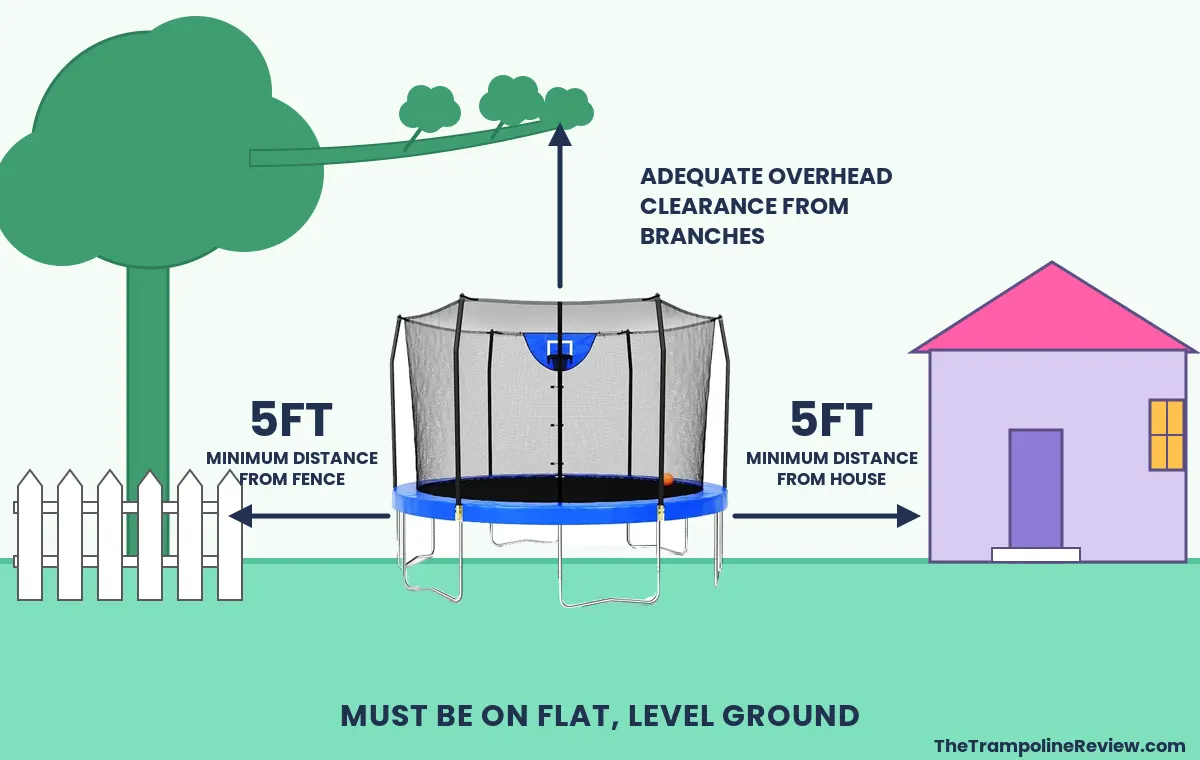
- Subtract clearance space on every side. Leave at least 3 to 6 feet around the whole trampoline.
- Whatever is left is the largest trampoline footprint you can fit.
- Lay out a garden hose or some painter's tape in that shape, so you can see the real size before you buy.
Ground, slope and overhead
Flat ground matters more than people think. A mild slope can work if you level it, but keep the gradient to no more than about 3 degrees across the whole space. Steeper than that and you add wear and wobble.
Look up too. You want open sky above the trampoline, with no branches, wires or roof overhangs in the way. A good rule of thumb is plenty of clearance overhead, and the ground below clear of sprinkler heads, rocks and roots.
What size trampoline do you need?
Size comes down to two things, really: how much yard you have, and who will be jumping. Full-size outdoor trampolines run from about 8 feet up to 16 feet, so there is a fit for almost any backyard.
As a quick rule, 8 to 10 feet suits younger kids and tight yards, 12 to 13 feet fits most families, and 14 feet or more is best for growing kids, teens and adults.
Match the size to who is jumping
Think a year ahead, not just today. Little kids grow, and friends come over. If your budget and space allow, sizing up once is easier than replacing the whole thing a couple of years later.
When in doubt, size up.
Round, square, rectangle, or oval: Which trampoline shape do you need?
Shape changes two things. How the trampoline bounces, and how well it fits your yard. Here is how the four common shapes compare.
Shape | Bounce feel | Best for | Space needed | Example |
|---|---|---|---|---|
Round | Softer, pulls you to the center | Younger kids, casual family play | Fits most yards | |
Oval | More even, roomy lengthwise | Medium yards, couple of jumpers | Medium | |
Square | Uniform, uses the corners | Confident jumpers, more usable space | More | |
Rectangle | Highest, most controlled | Athletes and gymnasts | Most |
Round trampolines guide jumpers back toward the middle, which is why they are the popular first pick for families. Oval models add length without hogging width. Square models give a more even bounce and use the corners. Rectangles give the biggest, most controlled bounce, but they cost more and need real space.
For most families a round or oval is the sweet spot.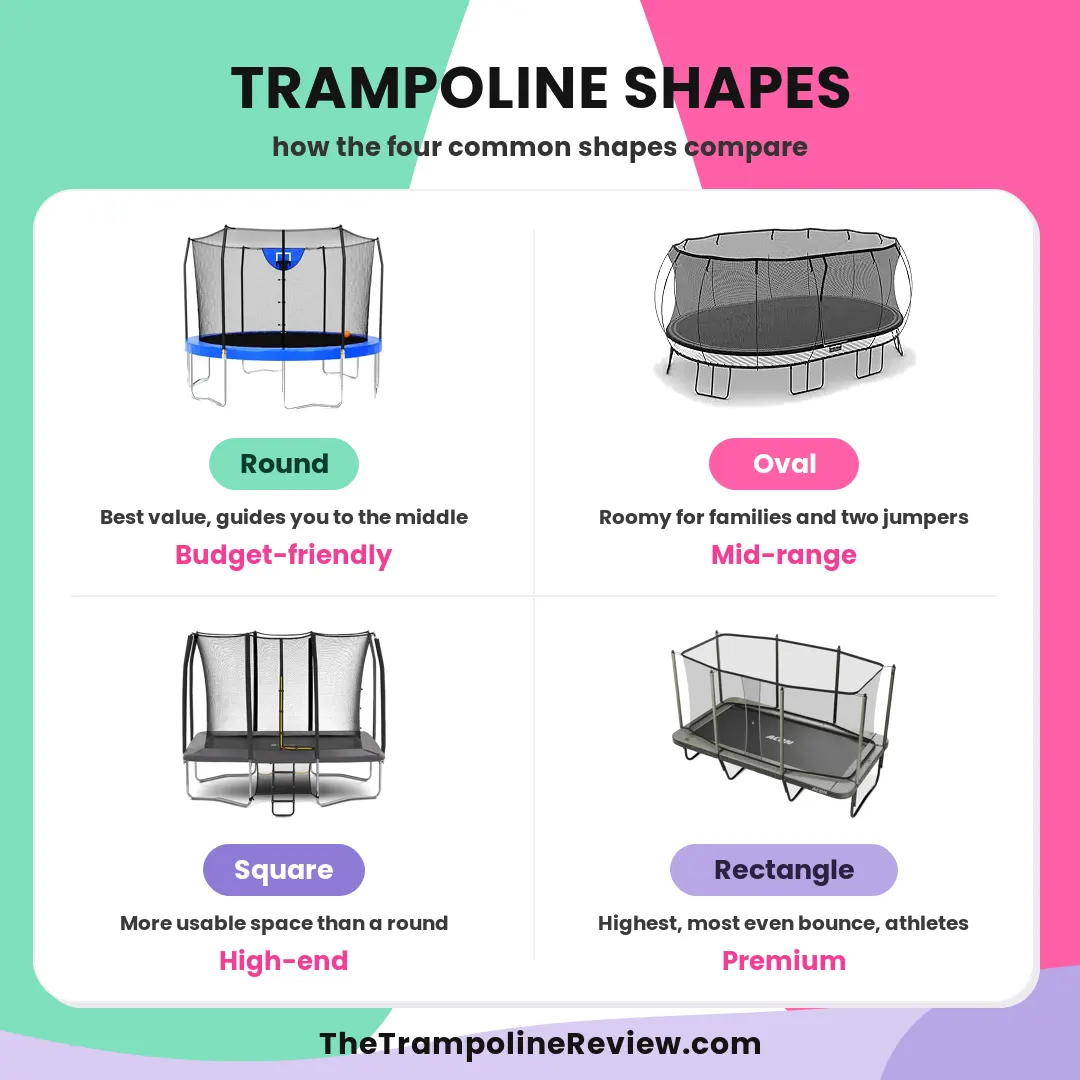
Weight limit: Single-jumper vs total capacity
Every trampoline lists a weight limit, and there are actually two numbers worth checking.
- Single-jumper weight limit. This is the number you need. On smaller models this can be around 175 pounds, rising to about 300+ pounds on larger ones.
- Total frame capacity. The combined weight the whole frame is rated to hold. Some trampolines don’t have a single jumper weight limit. The Acon Air 15 ft Gen 2.0 trampoline, for example, only has a frame limit of 1,650lbs.
Static vs. dynamic weight limit
Another marketing trick you should be aware of is that many manufacturers will advertise the static load of the trampoline. For example, 1,800 lbs. The thing is, “static weight load” is exactly what it sounds – it’s the weight limit if people are standing still on the trampoline.
The real weight limit and the number you actually need is the “dynamic weight load”. That’s how much the trampoline can hold when people are jumping on it. Usually, that’s a per-person weight limit. But it can also be for the entire trampoline.
When looking at weight limits, leave yourself headroom above the heaviest jumper, especially if a parent will use it for workouts.
Which trampoline safety features should you look for?
Here is the good news. Today's trampolines are built to a real safety standard, and a few features make a big difference for your family.
Consumer trampolines in the US are covered by two standards:
- ASTM F381-24. It sets out requirements for components, assembly, labeling and use. Worth knowing: that standard does not recommend large outdoor trampolines for children under 6.
- ASTM F2225-24. The official safety standard for consumer trampoline enclosures. It dictates rules for how nets, poles, and doors are made, tested, and labeled.
The safety features to look for
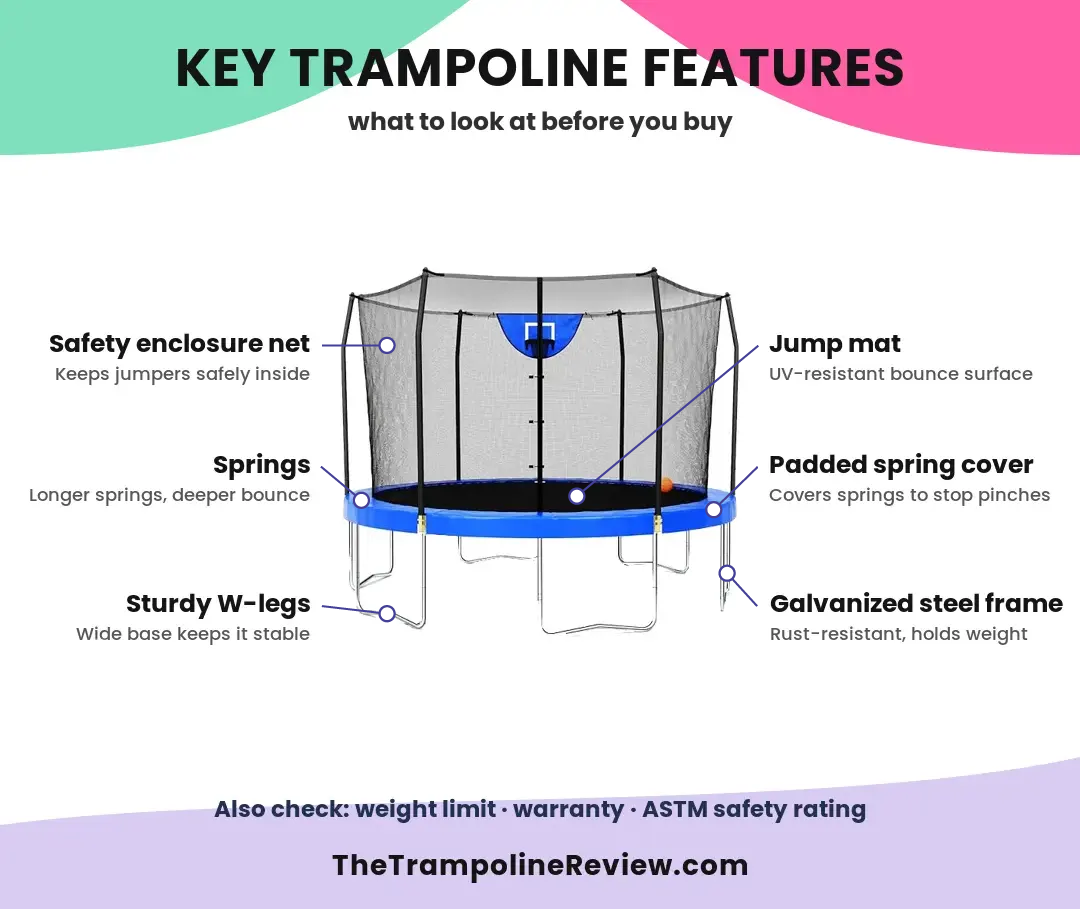
- Enclosure net that attaches inside the jumping area, so kids cannot reach the springs or frame.
- Thick spring padding, or a springless design that keeps hard parts away from the mat.
- A sturdy frame with wide legs, plus anchors or tie-downs if you get wind.
- A secure net entry, with a zipper or overlap that closes easily every time.
- Rounded poles so that kids don’t accidentally hit them. The padding does protect from injury, but this is an extra safety step I’d take.
One simple habit that helps most
The easiest safety win costs nothing. Keep it to one jumper at a time. Add a clear zone around the trampoline free of bikes, furniture and toys, keep an eye on younger kids, and you have covered the basics.
Springs vs. springless: Is a springless trampoline worth it?
This is a big either-or, and most guides push one side because they sell it. Here is the neutral version.
Traditional spring trampolines cost less and bounce well, as long as the spring padding is thick and in good shape.
Springless trampolines swap steel springs for various other flexible parts. Some use heavy-duty bungee cords flexible or composite rods under the mat, which keeps hard parts away from jumpers.
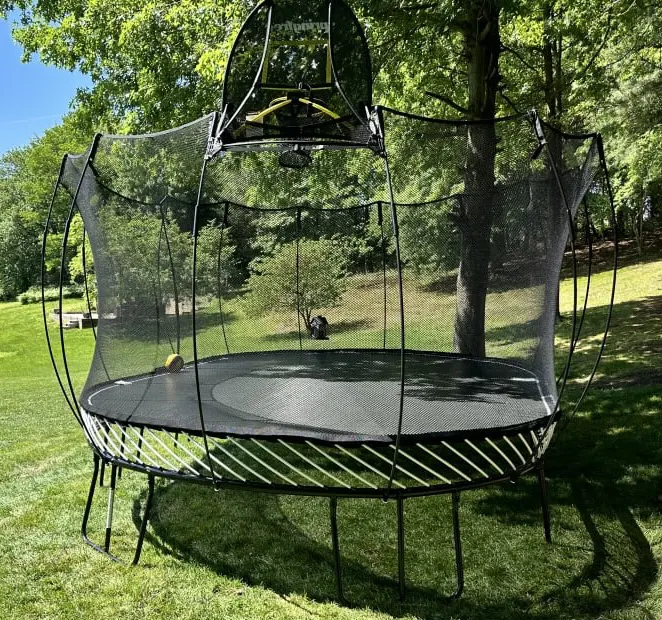
The best springless trampoline is made by Springfree (in the photo above).
Choose springless if you have young kids and want the extra peace of mind, and the budget allows. Keep in mind cheaper springless trampolines are less durable than their spring counterparts.
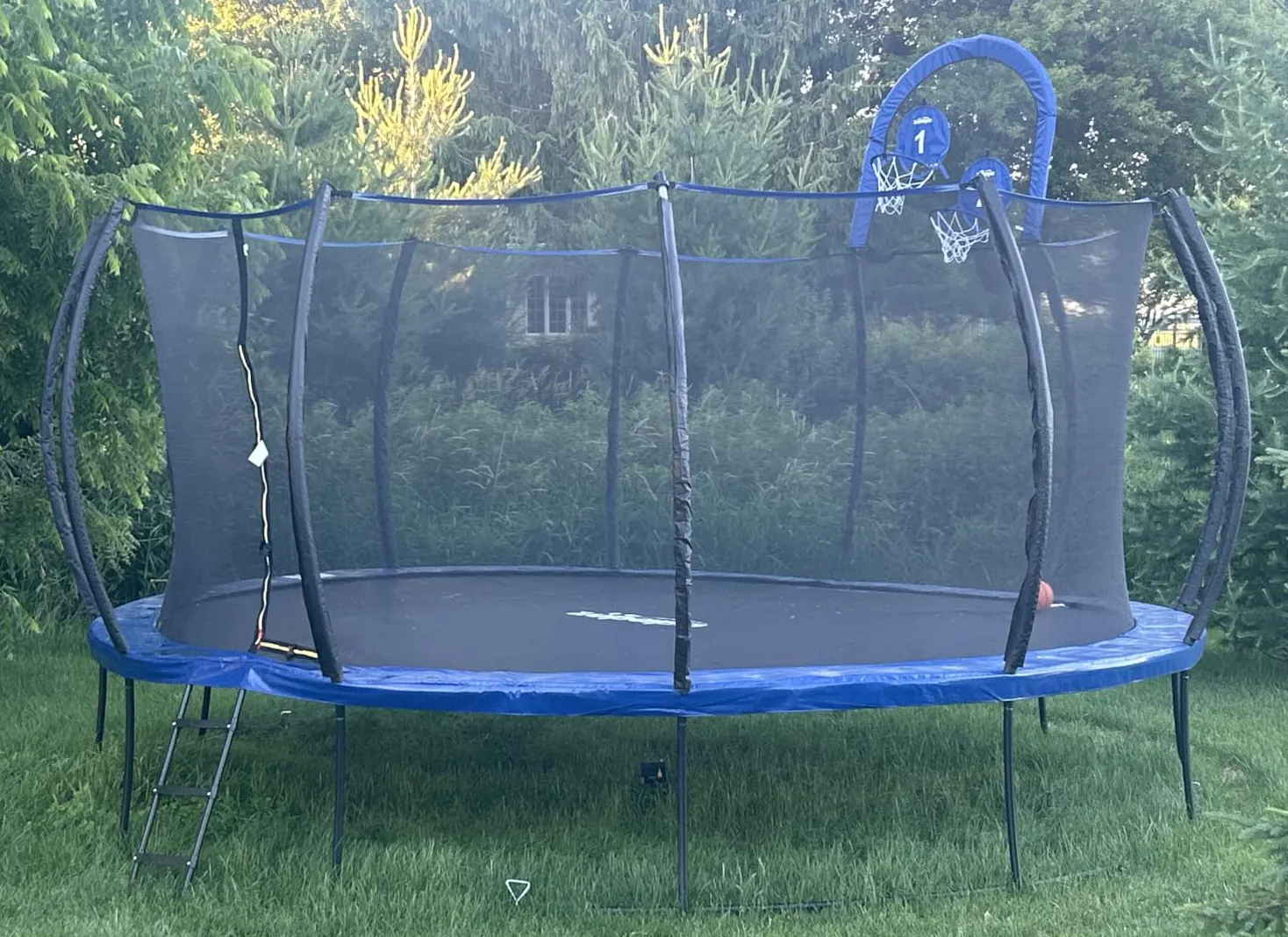
Choose a quality spring model if you want the best bounce for the money and will keep the padding maintained.
Neither is a wrong answer. All outdoor trampolines come with safety nets and the spring ones have padding over the springs, so there are enough safety features on both.
Build quality and weather durability
A backyard trampoline lives outside all year, through sun, rain and cold. Materials decide how long it lasts, so this is where quality pays off.
Look for these signs of a trampoline that will go the distance:
- Galvanized or powder-coated steel frame, which resists rust.
- A UV-resistant mat in polypropylene or similar, with reinforced stitching so it keeps its shape.
- Replaceable parts, so a worn pad, net or spring is a quick fix, not a new trampoline.
- A long warranty on key parts, ideally 10 years or more, which signals the maker trusts the build.
Buying replaceable parts and a solid warranty beats buying twice.
How much should you spend on a trampoline? Price by tiers.
You can spend $200 or well over $1,000. Here is what changes as the price climbs.
Price | Size | What you get | Example |
|---|---|---|---|
$200 to $350 | 8 to 10 ft | Basic model, fewer springs, thinner padding | |
$350 to $600 | 12 to 14 ft | Sturdier frame, better bounce, standard enclosure | |
$600 to $1,000+ | 15 to 16 ft or springless | Quality materials, enhanced safety, longer warranty |
More specialised models, such as rectangles and ovals, can run higher, from around $400 up to $3,000. Spend where it counts, which is the frame, the mat and the net. Skip the flashy extras you will not use.
Do you need HOA approval or insurance?
Before your trampoline arrives, spend five minutes on two boring but important checks.
First, your local rules. Some cities and homeowners associations set rules on setbacks, enclosure nets or anchors, and a few ask for approval first.
Second, your homeowners insurance, since some policies ask about trampolines. A quick call now saves a headache later.
Frequently asked questions
Can you keep the trampoline up all year?
Yes, most outdoor trampolines are built to stay out through the seasons, but a little seasonal care goes a long way. You can add a weather cover to prevent UV damage in the summer. In winter, brush off snow so the weight does not stretch the mat, and again, fit a weather cover to protect the pad and net from ice and leaves. If you get high winds, anchor the frame with an anchor kit.
What else can you use the trampoline for?
It’s actually very versatile! A trampoline doubles as a low-impact workout station for parents. You can also add a basketball hoop to turn it into a dunk zone, a tent to make it a backyard fort for sleepovers and stargazing, and sprinklers for summer fun.
How do you maintain a trampoline?
Maintenance is quick if you stay on top of it. Every few weeks, check the springs or rods for rust or wear, look over the mat and net for small tears, and make sure the frame pads still cover the edges. Tighten any loose bolts and clear leaves and debris off the mat. Cover it when it is not in use, brush off snow in winter, and replace worn pads, nets or springs as they go.
How many years does a trampoline last?
A well-made outdoor trampoline that is cared for usually lasts around 5 to 8 years, and often longer if you replace the mat, pads and springs as they wear. Weather is the biggest factor. A galvanized or powder-coated frame, a UV-resistant mat, and a cover in the off-season all add years. Cheaper models with thin materials tend to sag and rust sooner.
What are the benefits of trampoline exercise?
Bouncing is a fun, low-impact way to move that is gentler on the joints than running on pavement. Regular sessions can help build cardio fitness, balance and coordination, and core strength, and most kids and adults enjoy it enough to keep coming back. For families, the biggest benefit is simple: it gets everyone outside and active without feeling like a workout.
How many kids can jump on a 14ft trampoline?
A 14 ft trampoline has room for two or three kids, but the safest answer is one at a time. Most trampoline injuries happen when several people bounce together and collide or double-bounce each other. Check the single-jumper and total weight limits on the model, keep an eye on younger kids, and set a one-at-a-time house rule no matter how big the trampoline is.
Are cheap trampolines worth it?
It depends on how it will be used. A budget trampoline can be fine for younger kids and light, occasional play. The trade-offs show up over time: thinner padding, fewer or weaker springs, a less durable mat, and shorter warranties, so they often need parts sooner or get replaced within a couple of seasons. If the trampoline will get daily use or hold bigger kids and teens, spending a bit more on a sturdier frame, better net and solid warranty usually saves money in the long run.
When is the best time to buy a trampoline?
Demand rises in spring, often with promotions around early-season launches and holiday weekends. Late summer into early fall can also bring good prices as stores clear inventory. Planning ahead gives you more choice of size and shape.
The bottom line
Choosing a trampoline is simple once you take it in order. Start with your yard, then pick a size with room to grow, choose a shape that suits how your family plays, and check the weight limits. From there, prioritize safety features, solid build quality and a fair price.
Measure your space today, and you are halfway to the right choice. When you are ready to compare specific models, see our roundup of the best outdoor trampolines.
